
THE PORT OF SHANGHAI: NOT JUST A PORT, IT'S A "MEGACITY" ON THE WATER
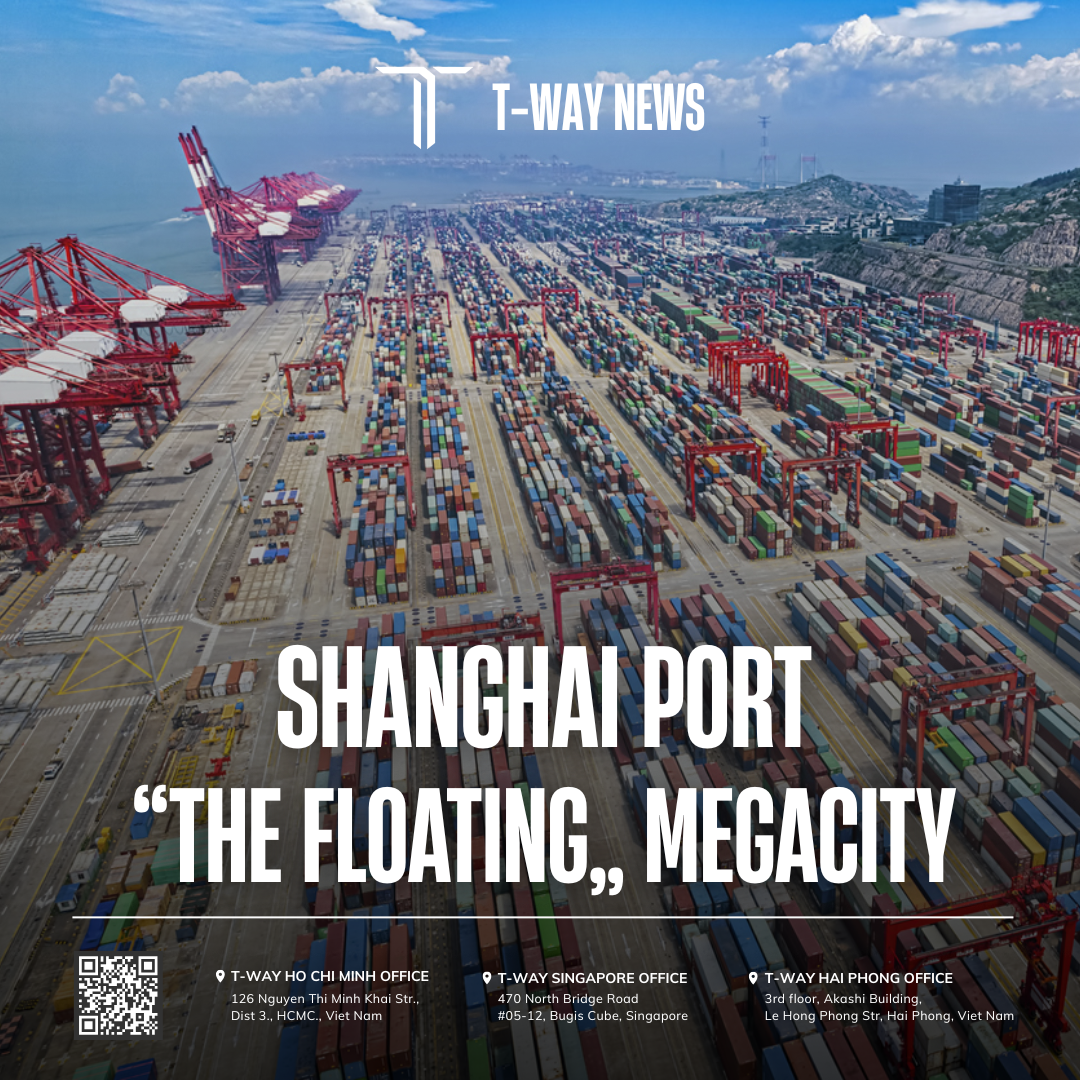
When mentioning a "seaport," most of us envision a stretch of coastline with a few rows of containers and docked cranes. But if you apply that imagination to the Port of Shanghai (China)—the busiest container port on the planet for over a decade—you are dead wrong!
The Port of Shanghai is actually a massive "logistics megacity," a masterpiece of mechanical engineering and automation. Let's break down just how huge this giant really is.
1. The Scale of a... Miniature Country
The "immensity" of the Port of Shanghai isn't just about its land area. Its total operational area reaches nearly 4,000 square kilometers (including both land and anchorage waters).
To put it into perspective:
This area is larger than the entire country of Luxembourg or the capital city of Hanoi.
The port spans three main areas: Along the Yangtze River, the Huangpu River, and extending far out into the East China Sea with the Yangshan Deep-Water Port.
2. "Mind-Blowing" Volume: The Heartbeat of Global Trade
Talking about its size without mentioning its capacity would be a huge omission. The Port of Shanghai handles nearly 50 million TEUs (20-foot equivalent units) annually.
-
If lined up back-to-back: This number of containers is enough to wrap around the Earth several times.
-
Processing speed: Imagine, with every passing second, several containers are being lifted or lowered. This colossal volume of goods accounts for a quarter of the total foreign trade value of China's billion-person economy.
3. An Engineering Marvel: Yangshan Deep-Water Megaport
The greatest highlight that defines the vastness of the Port of Shanghai is the Yangshan terminal area. Because the coastal waters of Shanghai were too shallow for mega-ships carrying thousands of TEUs, Chinese engineers made a crazy decision: Build the port right on remote offshore islands.
To connect the mainland with this reclaimed island cluster, they built the Donghai Bridge, stretching 32.5 kilometers—one of the longest cross-sea bridges in the world.
Driving from the mainland to the port takes nearly an hour over the ocean, a testament to a macro-planning vision that defies all geographical limits.
4. Vast but Far from Clunky (The Rise of Automation)
The larger a system is, the more prone it is to chaos. But the Port of Shanghai, especially Phase 4 of the Yangshan Port, operates smoothly to an eerie degree thanks to artificial intelligence (AI) and automation:
-
The "Unmanned" Zone: This is the world's largest fully automated terminal. You will see an endlessly vast container yard completely devoid of human presence.
-
An Army of Robots: Hundreds of Automated Guided Vehicles (AGVs) weave together rhythmically under the coordination of a central AI system, automatically calculating the shortest routes and avoiding collisions. The giant cranes are operated remotely by engineers sitting in air-conditioned rooms dozens of kilometers away.
The immensity of the Port of Shanghai is not just measured in square kilometers or the number of gantry cranes. It is measured by the ambition to master the global supply chain, by breakthroughs in automation technology, and by its ability to connect billions of consumers worldwide.
Shanghai hasn't just built a port; they have built a "perpetual engine" reshaping the global maritime map.