

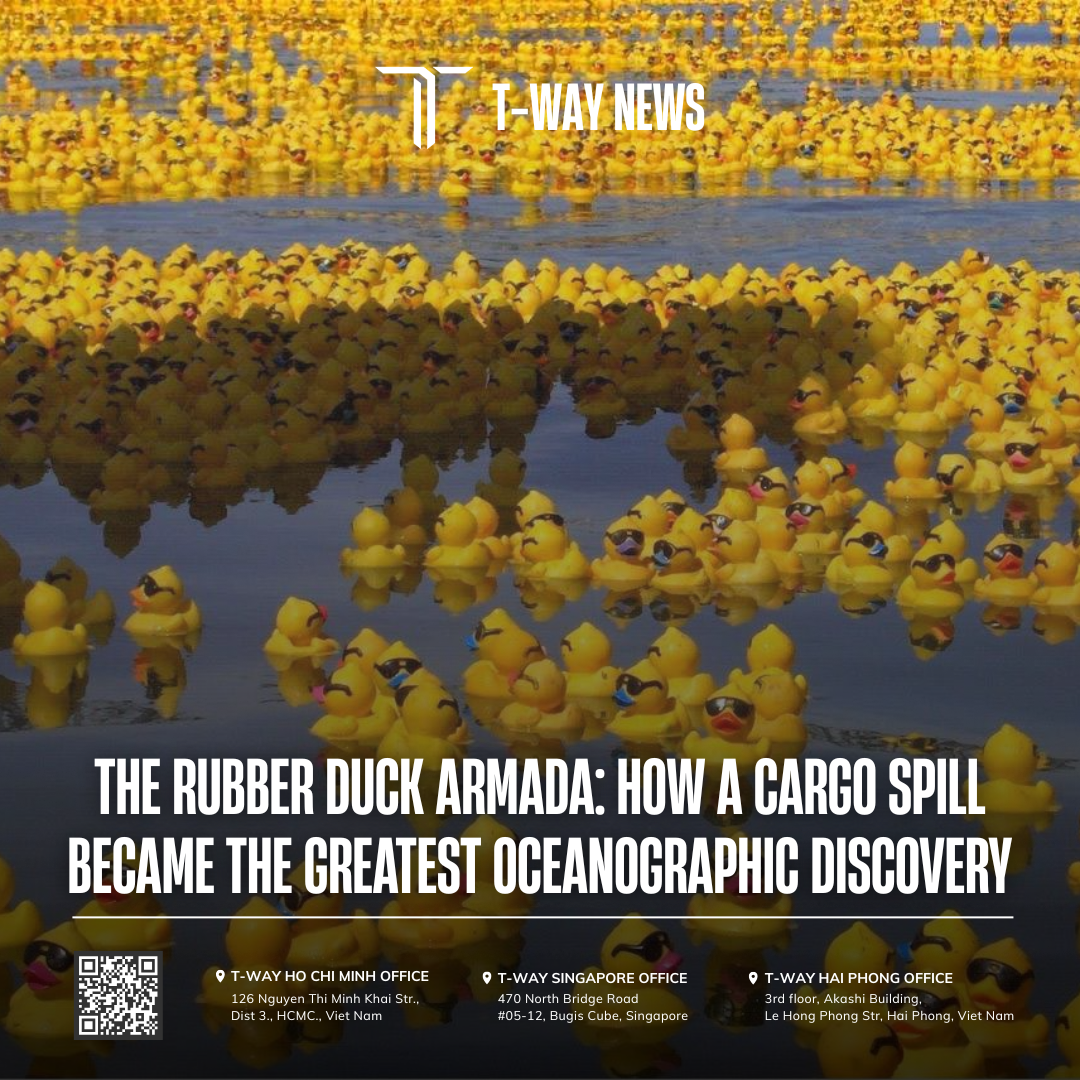
What would you do if you dropped 28,000 toys into the middle of the Pacific Ocean? Most would consider it a costly shipping disaster. But for the scientific community, this lost container incident was the beginning of one of the greatest and... most adorable experiments in history!
Let's open the case file on the incredible adventure of the "Friendly Floatees Fleet"!
The Stormy Night of 1992 In January 1992, a cargo ship departed from Hong Kong carrying containers full of bath toys, en route to Tacoma, Washington (USA).
Passing through the North Pacific, the ship suddenly encountered a violent storm. Giant waves washed a container overboard. The immense impact ripped the container open, releasing 28,000 "warriors" including: yellow ducks, green frogs, blue turtles, and red beavers.
Instead of sinking to the deep bottom, these toys were designed to be completely sealed, with no holes for water to enter. And just like that, the "Friendly Floatees Fleet" officially set sail, beginning a grand maritime voyage.
The Savior Named Curtis Ebbesmeyer This incident might have just been filed away as an insurance claim and faded into oblivion if it weren't for the appearance of oceanographer Curtis Ebbesmeyer. Realizing this was a "once-in-a-lifetime" opportunity, he established a large-scale tracking network.
Releasing 28,000 floating objects simultaneously at a single point in the middle of the ocean is something no scientific project would have the budget to pull off. Thanks to their vibrant colors and perpetual buoyancy, these ducks inadvertently became the perfect "tracking devices" to map global ocean currents.
The Cross-Continental Journey The journey of this fleet is just as thrilling as any adventure movie:
-
November 1992 (10 months later): The first batch washed up on the shores of Alaska, completing a 3,200 km drift.
-
1995: A group of the fleet got trapped in giant ice floes in the Arctic. They moved slowly at a pace of about 1 mile per day, gradually crossing the North Pole of the Earth.
-
2000 - 2001: The ice melted. The ducks "resurrected" and headed straight into the North Atlantic.
-
2003 - 2007: They successively appeared on beaches on the East Coast of the US, England, and even Scotland.
Many ducks drifted over 27,000 km, faded by the sun and wind, cracked by the frost, yet still floated proudly on the water's surface.
The Invaluable Legacy Left Behind The rubber duck fleet's adventure, lasting over a decade, was no joke; they provided a massive amount of data that helped scientists:
-
Accurately determine the speed, cycle, and direction of Ocean Gyres.
-
Predict the paths of plastic waste and marine oil spills to develop intervention measures.
-
Discover the exact time it takes for ocean water to circulate from the Pacific to the Atlantic via the Arctic.
Conclusion: Sometimes, unintended accidents bring about value far beyond our imagination. Next time you take a walk on the beach and happen to pick up a faded toy, there's a good chance you are holding a "great explorer" that has traveled around the Earth!