
THE TITAN OF NINGBO-ZHOUSHAN AND THE ART OF MULTIMODAL CONNECTIVITY
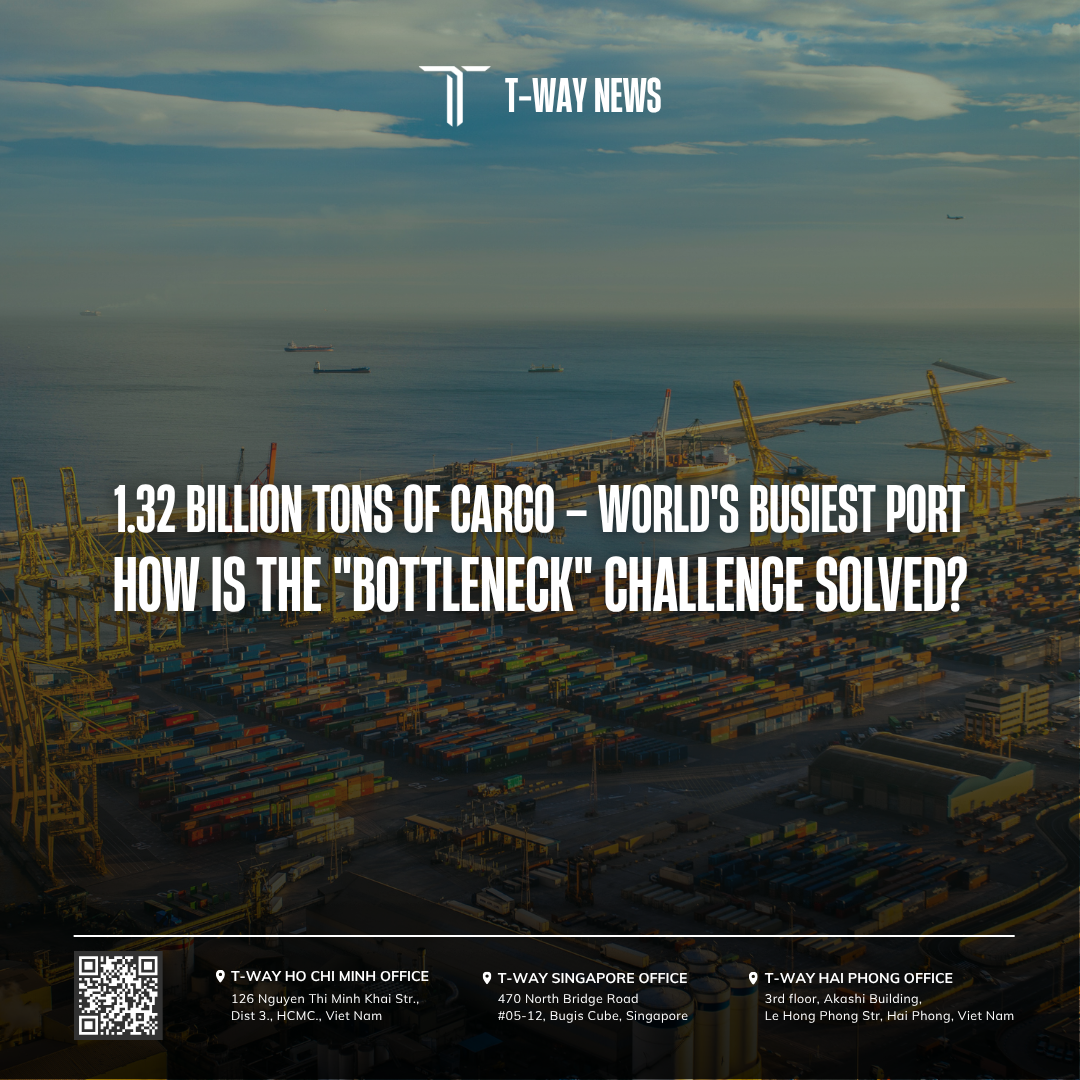
1.32 Billion Tons of Cargo: How the World's Busiest Seaport Solves the "Bottleneck" Problem
The Port of Ningbo-Zhoushan is breathtaking not just because of its sheer scale (ranking No. 1 globally in total cargo throughput for consecutive years), but also due to how it masterfully handles the logistical challenge of moving a massive volume of goods deep into the hinterland.
-
Natural Deep-Water Advantage: The port can easily accommodate the world's largest mega-container ships, optimizing transportation costs per TEU for shipping lines.
-
Sea-Rail Multimodal Transport: The most fascinating aspect of Ningbo-Zhoushan is its rail network, integrated directly into the docks. Once unloaded from ships, cargo is immediately transferred onto trains, seamlessly joining the Eurasian rail network.
-
Optimized Customs Clearance: Physical speed means nothing if operations get bogged down by paperwork. Synchronizing electronic data flows allows goods to be cleared while still in transit, minimizing yard storage time.
Expert Insight: The true scale of a seaport is measured not just by its number of gantry cranes, but by its capacity to clear cargo quickly. The seamless integration of maritime shipping, rail transport, and automated customs clearance is the ultimate key to reducing lead times for import-export businesses.
1. Deep-Water Advantage: The "Magnet" for Mega-Ships
Ningbo and Zhoushan were previously two independent ports, but they merged to fully optimize their geographical layout.
-
Strategic Location: Situated at the center of China's coastline, right at the gateway to the Yangtze River Delta economic hub.
-
Navigation Channel Depth: Featuring natural deep-water channels ranging from -18 meters to over -22 meters. This allows the port to effortlessly handle next-generation mega-container ships (behemoths with capacities of 20,000 to 24,000 TEUs) or 300,000-ton crude oil tankers without having to wait for high tide.
-
The Economic Equation: The larger the ship, the cheaper the shipping cost per container (economies of scale). Major shipping lines are virtually forced to choose Ningbo-Zhoushan as their primary port of call.
2. Sea-Rail Intermodal Transport
This is the "secret weapon" that prevents yard congestion despite a staggering, continuous influx of cargo.
-
Tracks by the Water's Edge: Instead of loading containers onto trucks and driving to a railway station miles away, terminals like Chuanshan feature rail tracks running directly alongside the berths. Cranes lift containers from ships and place them straight onto train cars.
-
The Yiwu-Ningbo Corridor: Yiwu is dubbed the "world's largest small-commodity wholesale market." An intermodal rail system operating continuously between Yiwu and the Port of Ningbo creates a non-stop cargo stream. Goods leave the factory floor $\rightarrow$ get on a train $\rightarrow$ roll straight into the port $\rightarrow$ and board a container ship in less than a single day.
-
Transcontinental Connectivity: This rail route links directly to the New Eurasian Land Bridge network, allowing maritime cargo to travel deep into mainland China, Central Asia, and all the way to Europe without unloading containers along the way.
3. Digitization and "Non-Stop" Customs Clearance
No matter how fast mechanical handling is, everything falls apart if paperwork stalls. Ningbo-Zhoushan tackles this by implementing:
-
Electronic Customs (Single Window): A national single-window system directly connecting shipping lines, ports, logistics agencies, and customs authorities.
-
Pre-arrival Clearance: While a ship is still hundreds of nautical miles away, its entire manifest data is transmitted to the customs AI system. Channeling (Green/Yellow/Red) and risk assessments are carried out automatically. By the time the vessel docks, the majority of containers categorized under the Green channel are loaded straight onto trucks or trains to exit the port immediately, completely bypassing storage wait times for approval.